

_500x500.jpg)
『Furnace Air Flow Meter Controls: Optimizing Combustion Efficiency via Precise Volumetric Feedbacks』Related information(clamp on meter|electromagnetic meter|venturi meterrotameter|orifice meter|ultrasonic flow meter|mass flow meter|coriolis mass flow meter|coriolis flow meter|magnetic flow meter|magmeter flow meter|magflow flow meter|mag meter flow meter|electromagnetic flow meter|vortex flow meter|turbine flow meter|thermal mass flow meter|thermal flow meter|rotameter flow meter)
Furnace Air Flow Meter Controls: Optimizing Combustion Efficiency via Precise Volumetric Feedbacks
Quick Answer: A furnace air flow meter with a live volumetric output helps burner controls hold the correct air fuel ratio and reduce fuel waste. Thermal mass and vortex flow meters are the two practical choices for most combustion air lines from DN15 to DN300. Silver Automation Instruments supplies both meter types with 4-20 mA HART, RS485 Modbus, and optional ATEX Zone 1 certification.
Why Furnace Air Flow Measurement Is the Weak Link
Most burner controls monitor fuel pressure and temperature but not combustion air flow. In practice, air flow changes with filter loading, damper position, fan wear, and barometric pressure. Without direct volumetric feedback, the burner controller guesses. A small drift of 5 percent in air flow can push excess oxygen up or down. That changes flame temperature, stack loss, and NOx. We have seen this on customer sites many times.
Process engineers in steel reheat furnaces, glass melters, ceramic kilns, and chemical process heaters ask for compressed air or forced draft air measurement. They want a meter that gives them normal cubic meters per hour or standard liters per minute. They also want a signal their DCS or PLC can use without extra signal conditioners.
Which Flow Meter Fits Combustion Air Lines
For clean dry combustion air, a thermal mass flow meter is often the first option. It reads mass flow directly without separate pressure and temperature compensation. A typical Silver Instruments thermal flow meter covers line sizes from DN15 to DN200. It handles gas temperatures up to 200 degrees Celsius and pressure up to 40 bar. Output options include 4-20 mA, HART, and RS485 Modbus.
For larger ducts, hot air, or dirty air after a preheater, a vortex flow meter can be a better fit. Silver Instruments vortex meters work from DN15 to DN300. They measure volumetric flow at line conditions. If the furnace air line runs above 150 degrees Celsius, a remote electronics version with a PT100 temperature sensor input is available. The meter sends the flow signal and temperature signal to the burner management system together.
Differential pressure flow meters with orifice plates are still common on older furnaces. But most engineers skip this part for new installations. They do not want impulse lines, condensation traps, or square root extraction. A direct insertion thermal meter or inline vortex meter reduces leak points and maintenance hours.
Volumetric Feedback That Burner Controls Actually Use
Here is the thing. A flow meter only helps if the output matches the control loop. Most burner systems accept 4-20 mA analog input with HART for diagnostics. Some sites in the Middle East and Southeast Asia use Modbus RTU over RS485 to send flow, total flow, and temperature to a PLC. Silver Automation Instruments can supply either signal format on the same meter model. The display shows standard volumetric flow, gas temperature, and totalized flow. You can set low flow and high flow alarms through the keypad.
Because combustion air flow changes quickly, a response time under 1 second is often required. Thermal mass meters with constant power probes typically respond in 0.5 to 1 second. Vortex meters respond fast too but may need a minimum flow velocity of about 2 to 4 meters per second in smaller lines. For low fire conditions on a burner, check the turndown ratio. Thermal mass meters often give a 100:1 turndown. That means the same meter can read pilot air flow and full load air flow.
Sizing and Installation Details for Industrial Furnaces
Do not size the meter on pipe diameter alone. Send the actual flow range in kg/h, Nm3/h, or SLPM. Include the minimum and maximum values. For combustion air lines, common flows range from 20 Nm3/h on small kilns to more than 5000 Nm3/h on large reheat furnaces. Pressure runs from 50 mbar to
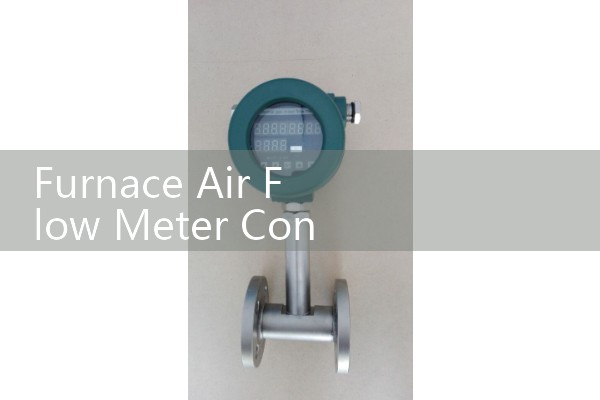
Installation is simple. For inline vortex meters, keep 15 DN straight run upstream and 5 DN downstream. For thermal mass insertion meters, follow the probe depth marking. In vertical lines, install the meter with upward flow to keep condensate from settling. In horizontal lines, avoid the lowest point where moisture collects. If the furnace uses preheated combustion air above 200 degrees Celsius, use a remote converter mounted away from the hot pipe.
For hazardous area burners, select ATEX Zone 1 or Zone 2 certification. Silver Automation Instruments supplies Ex d and Ex ia versions for gas and dust atmospheres. The certification covers the sensor and the transmitter. This matters in petrochemical plants, paint drying ovens, and gas processing sites in Southeast Asia and the Middle East.
A Real Site Example from Vietnam
Last year a customer in Vietnam asked us for a furnace air flow meter on a ceramic kiln. They had high gas consumption and unstable kiln temperature. The burner control used only gas pressure and a manual air damper. We supplied a DN80 thermal mass flow meter with 4-20 mA HART output and a local display. The site installed it on the forced draft air line after the filter but before the burner manifold. After calibration, the kiln operator saw air flow vary from 180 to 240 Nm3/h during each firing cycle. The PLC now trims the combustion air damper based on live flow. The customer reported a gas saving of about 6 percent in the first three months.
How to Get a Quote from Silver Automation Instruments
Tell us the gas type, flow range, pressure, temperature, pipe size, and signal output. For air and flue gas applications, include the normal and maximum Nm3/h. For oxygen enriched air or hot flue gas, also mention oxygen percent and dew point. Send your pressure in bar, temperature in degrees Celsius, pipe size in DN, and flow range to our engineers.
Contact Silver Automation Instruments today.
Tel: +86-25-68650347
Whatsapp: +86-25-52155837
WeChat: +86 15365082610
Full product details are available at flow-meter.com.au.
We supply thermal mass flow meters, vortex flow meters, electromagnetic flow meters, Coriolis mass flow meters, ultrasonic flow meters, oval gear flow meters, pressure transmitters, and paperless recorders to industrial users and distributors in Southeast Asia, Oceania, Latin America, Africa, and the Middle East.
FAQ
1. What is the best flow meter for furnace combustion air
A thermal mass flow meter is often the best for clean dry combustion air because it reads mass flow directly and has a wide turndown ratio. For larger ducts or hot air, a vortex flow meter works well.
2. Do I need temperature and pressure compensation for furnace air flow
If you use a thermal mass flow meter, the meter reads mass flow and does not need separate compensation. If you use a vortex meter, the flow rate is at line conditions and may need pressure and temperature inputs for standard volumetric units like Nm3/h.
3. Can the flow meter connect to my existing burner management system
Yes. Silver Automation Instruments provides 4-20 mA HART, pulse, and RS485 Modbus outputs. Most burner controllers and PLC systems accept one of these signals.
4. What pipe sizes do you cover for furnace air flow meters
We cover DN15 to DN300 for inline flow meters. Insertion thermal mass flow meters can cover larger ducts from DN300 to DN2000 or more depending on the duct size and probe length.
5. What information do I need to send for a quote
Send the gas type, flow range in Nm3/h or kg/h, pressure in bar, temperature in degrees Celsius, pipe size in DN, and required signal output. Our team will reply with a model suggestion and price.
 Hot Product
 Related AD