

『Full Bore Electromagnetic Flow Meter Advantages: Zero Pressure Drop and Obstructionless Liquid Sizing』Related information(clamp on meter|electromagnetic meter|venturi meterrotameter|orifice meter|ultrasonic flow meter|mass flow meter|coriolis mass flow meter|coriolis flow meter|magnetic flow meter|magmeter flow meter|magflow flow meter|mag meter flow meter|electromagnetic flow meter|vortex flow meter|turbine flow meter|thermal mass flow meter|thermal flow meter|rotameter flow meter)
Full Bore Electromagnetic Flow Meter Advantages: Zero Pressure Drop and Obstructionless Liquid Sizing
Quick Answer: A full bore electromagnetic flow meter keeps the same internal diameter as the process pipe. It does not reduce the pipe ID, so it adds no measurable pressure drop and has no internal parts that block the liquid path. This design works well for wastewater, sludge, mining slurry, and conductive chemical batching. Send your pipe size, pressure, temperature, flow range, and liquid conductivity for a Silver Instruments quote.
What Full Bore Means in a Magnetic Flow Meter
Full bore means the sensor tube has the same diameter as the adjacent pipe. A DN100 pipe uses a DN100 full bore meter. There is no reducer, no cone, and no step change inside the meter. This is different from reduced bore magmeters that shrink the flow path to increase velocity and signal strength.
In practice, a full bore magmeter keeps the velocity profile stable. It does not force the liquid through a smaller opening. That matters when the liquid carries solids or fibers. A reduced bore can catch those solids at the inlet. A full bore cannot.
Zero Pressure Drop: Why It Matters
Pressure drop across a flow meter costs real money in pumps and energy. A full bore electromagnetic flow meter has no moving parts and no change in pipe diameter. The measured pressure loss is close to zero. In long transfer lines, this keeps discharge pressure available for the process instead of wasting it at the meter.
We have seen this matter in water supply projects in Southeast Asia. A customer in the Philippines replaced an orifice plate with a DN300 full bore magmeter. The pump discharge pressure stayed the same but the reported flow was easier to read and the meter did not clog. That is the kind of upgrade engineers understand immediately.
Obstructionless Flow Path for Dirty Liquids
Full bore magmeters have only a liner and two or three electrodes in contact with the liquid. Nothing protrudes into the flow stream. The meter stays obstructionless for practical industrial purposes. Sludge, paper pulp, mining tailings, and wastewater with rags pass through without hanging up on an internal bluff body.
We recommend a full bore meter for any liquid that can form strings, settle, or coat the pipe wall. For example, a food plant in Vietnam meters spent wash water with a DN80 full bore magmeter. The meter runs 24 hours a day and the maintenance crew only checks the grounding and liner condition during scheduled shutdowns.
Sizing Tips for Full Bore Magmeters
Liquid sizing for a full bore electromagnetic flow meter starts with the pipe ID and the flow range. Select the meter size to match the pipe ID. Do not downsize the meter to save cost. A full bore meter should be sized so the flow velocity stays between 0.3 m/s and 10 m/s. Most industrial liquids meter well between 1 m/s and 5 m/s. Below 0.3 m/s the signal from a full bore design can be weak, especially for larger diameters.
You need to share a few data points with us for a proper size check. Send the pipe size in DN, minimum and maximum flow in m3/h, liquid conductivity in µS/cm, pressure in bar, and temperature in °C. We will confirm the liner, electrode, and flange rating. This is a standard request for water, chemical, or food plants.
Liner and Electrode Selection
Full bore magmeter liners handle different chemical and temperature ranges. Hard rubber works for water and wastewater between 0 °C and 80 °C. PTFE works for aggressive acids and high temperatures up to 120 °C or 150 °C depending on the transmitter. Polyurethane works for abrasive slurry. The right liner keeps the full bore design reliable over many years.
Electrode materials matter just as much. 316L is the default for water and mild chemicals. Hastelloy C resists strong acids. Titanium works for seawater and brine. Tantalum works for concentrated acids. Platinum works for some specialty food and chemical streams. We stock most combinations with flanged connections from DN10 to DN2000.
Installation and Grounding Notes
Full bore magmeters need a straight run upstream and downstream for a stable velocity profile. A common rule is 5D upstream and 3D downstream. This is not as strict as an orifice plate but it helps the meter reach its published accuracy. Keep the sensor
Grounding is critical for electromagnetic flow meters. The instrument measures microvolt signals. A poor ground creates noise and unstable readings. Use the grounding rings or grounding electrodes supplied with the meter. For lined steel pipe, ground the sensor to the pipe flanges. For plastic pipe, use grounding rings on both sides.
Silver Instruments Full Bore Magmeter Range
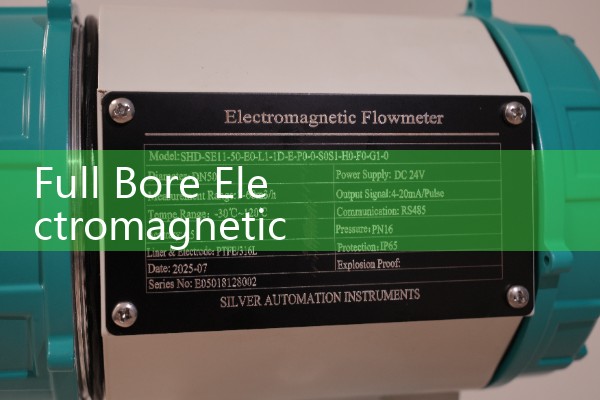
Silver Automation Instruments supplies full bore electromagnetic flow meters from DN10 to DN2000. Our full bore electromagnetic flow meter series, SIL-MAG-FB, covers most industrial liquid applications. The standard accuracy is 0.5 percent of reading. Optional accuracy is 0.2 percent of reading for clean conductive liquids. Outputs include 4-20 mA HART, pulse, frequency, and RS485 Modbus. Flange standards cover ANSI, DIN, JIS, and wafer styles for tight spaces.
We keep standard sizes in stock for water and wastewater projects: DN25, DN40, DN50, DN80, DN100, DN150, DN200, DN250, DN300. Larger sizes up to DN2000 are built to order with a short lead time. The display is local and the transmitter housing is IP67 or IP68 for flooded pits. Ex approvals are available for ATEX Zone 1 and Zone 2 when your site requires certified instruments.
Common Liquids and Applications
Full bore magmeters work on conductive liquids only. The liquid must have a minimum conductivity of 5 µS/cm for most models. This covers potable water, river water, seawater, wastewater, sludge, chemical acids, caustic soda, beer, milk, fruit juice, and some pharmaceutical liquids. The meter does not work on oils, solvents, and ultrapure water with very low conductivity.
We have supplied full bore meters for desalination plants, cooling water circuits, palm oil mill effluent, fish farm seawater intake lines, paper stock, and milk transfer in a dairy. The same zero pressure drop benefit applies to all of these installations. The meter does not add load to the existing pump system.
Full Bore vs Reduced Bore Magmeter
A reduced bore magmeter can be attractive because the smaller tube raises velocity. That can improve accuracy at very low flow rates. But it introduces a pressure drop and two step changes that can trap solids. A full bore magmeter cannot trap solids because the ID does not change. If your liquid has fibers, rags, or particles, choose full bore. If your liquid is clean and the line pressure budget is tight, still choose full bore for simplicity.
Most engineers skip this part of the comparison. They look at the initial purchase price only. However, a reduced bore meter may need more frequent cleaning in dirty service. The full bore meter costs a little more in larger sizes but the operating cost is lower. That has been our experience on customer sites in Latin America and the Middle East.
FAQ
1. What does full bore mean in an electromagnetic flow meter?
Full bore means the flow sensor has the same internal diameter as the pipe. There is no reduction in cross section at the measuring point.
2. Does a full bore magmeter really have zero pressure drop?
For most clean and dirty liquids the pressure drop is negligible because the pipe ID does not change. There are no moving parts or restrictions inside the tube.
3. What is the minimum liquid conductivity?
The liquid should have at least 5 µS/cm. Demineralized water, most oils, and dry gases will not produce a reliable reading.
4. What size range does Silver Instruments offer?
We supply full bore magmeters from DN10 to DN2000. Standard flanged sizes from DN25 to DN300 are often in stock for fast delivery.
5. How do I send an inquiry for a full bore magmeter?
Send your DN size, flow range in m3/h, liquid name and conductivity, pressure in bar, temperature in °C, and your country. We will reply with a specific model and price.
For a firm quotation, send us your pressure in bar, temperature in °C, pipe size in DN, flow range in m3/h, and liquid conductivity. Contact Silver Automation Instruments at Tel: +86-25-68650347. Whatsapp: +86-25-52155837. WeChat: +86 15365082610. You can also visit our website flow-meter.com.au for full bore electromagnetic flow meter product details.
 Hot Blog
 Related AD