

『Liquid Refrigerant Flow Meter: Preventing Sensor Flashing Through Proper Subcooling』Related information(clamp on meter|electromagnetic meter|venturi meterrotameter|orifice meter|ultrasonic flow meter|mass flow meter|coriolis mass flow meter|coriolis flow meter|magnetic flow meter|magmeter flow meter|magflow flow meter|mag meter flow meter|electromagnetic flow meter|vortex flow meter|turbine flow meter|thermal mass flow meter|thermal flow meter|rotameter flow meter)
Liquid Refrigerant Flow Meter: Preventing Sensor Flashing Through Proper Subcooling
Quick Answer: Sensor flashing in liquid refrigerant flow meters almost always means vapor bubbles are hitting the sensor. The fix is not a different meter. The fix is proper subcooling. Keep the liquid refrigerant 5 to 7 degrees Celsius below its saturation temperature, and the signal will stay rock solid. A Coriolis flow meter will then give you a true mass flow, no flashing, no drift.
Why Sensor Flashing Happens in Refrigerant Lines
Most engineers see the flashing problem on site and blame the flow meter. That is usually the wrong call. The real cause is two-phase flow. Even a small amount of vapor bubbles in the liquid line will cause rapid density changes. A Coriolis meter measures mass flow and density in real time. When a bubble hits the vibrating tube, the density reading spikes low. The transmitter interprets this as an error. The output may blink, go to zero, or throw a diagnostic alarm.
We have seen this on ammonia refrigeration systems in Vietnam, on R507 lines in Malaysia, and on seafood freezing plants along the coast of Ecuador. In each case the operators were convinced the flow meter was faulty. In each case the liquid refrigerant was sitting right at its saturation point. A small pressure drop in the pipe before the meter was enough to start flashing.
What Subcooling Means for Flow Meter Performance
Subcooling is the difference between the saturation temperature at the local pressure and the actual temperature of the liquid. If you have R404A at 18 bar gauge, the saturation temperature is roughly 40 degrees Celsius. If the liquid coming out of the receiver measures 35 degrees Celsius, you have 5 degrees of subcooling. That is the minimum we recommend for stable flow measurement. For long pipe runs or vertical risers before the meter, target 7 to 10 degrees of subcooling.
Here is the thing: a flow meter cannot add subcooling. It can only report what it sees. A Coriolis flow meter, like our Silver Instruments SICM series, will measure density as low as 0.2 kg/m3 deviation. That means the moment even a tiny bubble passes through, you will see it in the live density trend. If your subcooling is marginal, you will see intermittent flashes all day long.
How Much Subcooling Is Enough for a Reliable Signal
In practice, 5 degrees Celsius is the sweet spot for most industrial cooling systems. We have a customer in Indonesia running a large ice cream cold storage. They use a DN25 Coriolis meter on the ammonia liquid line. Their subcooling is maintained at 6 degrees Celsius. Zero sensor flashing over 18 months of operation. Another site, a paint additive plant in Thailand, had subcooling of only 2 degrees. The flow meter was flashing roughly every 40 seconds during the afternoon shift when ambient temperature rose. Adding a small subcooling heat exchanger fixed it completely.
But do not just guess. Measure the pressure at the flow meter inlet, not at the receiver. Measure the temperature right at the meter body. Use a PT100 with a fast response time. The difference between these two points is what matters. A pressure drop of just 0.3 bar in the pipe can wipe out your subcooling margin.
Selecting the Right Flow Meter for Liquid Refrigerant
For liquid refrigerant measurement with subcooling control, we almost always recommend a Coriolis mass flow meter. It handles density changes. It is immune to viscosity shifts. The common sizes for ammonia and Freon-based systems are DN15, DN25, and DN50. Our SICM series comes with ATEX Zone 1 cert
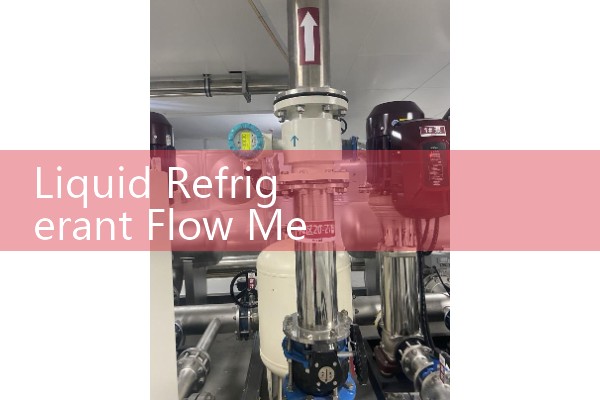
Some engineers ask if a vortex flow meter can do the job. A vortex meter will also react badly to bubbles because the bluff body sheds irregularly in two-phase flow. Ultrasonic clamp-on meters struggle with signal loss if even a trace of vapor is present. A Coriolis meter with the right subcooling simply works.
A Real Installation Sequence That Prevents Flashing
We worked with a contractor in Abu Dhabi last year. They were retrofitting a large cold store that uses R290 propane. The original turbine flow meter was flashing every time the defrost cycle ended. Steps we took. First, we moved the flow meter to the lowest point in the liquid drain line, right after the receiver, to maximize static head. Second, we installed a sight glass immediately upstream. Third, we set the condenser outlet subcooling to 8 degrees Celsius at full load. Fourth, we swapped the turbine meter for a DN40 Coriolis mass flow meter. The sight glass now stays full with clear liquid. The 4-20 mA signal goes straight and steady to the PLC. The plant manager told us they no longer get midnight alarm calls.
Contact Silver Automation Instruments
If you are dealing with a flashing sensor on your refrigerant flow meter, send us the following data. Pressure at the meter, temperature at the meter, pipe size (DN), refrigerant type, and the flow range you want to measure. We will propose a meter with the right subcooling margin built into the spec. You do not need to guess.
Email: [email protected]
Tel: +86-135-1213-1526
Whatsapp: 86-135-12131526
WeChat: +86 13512131526
See our full range of Coriolis flow meters for liquid gas and refrigerant on flow-meter.com.au.
Frequently Asked Questions
What causes sensor flashing in liquid refrigerant flow measurement?
Vapor bubbles passing through the sensor cause rapid density variation. The transmitter sees this as a fault and the output signal flickers or drops to zero. The root cause is almost always insufficient subcooling, not a meter defect.
How much subcooling is needed to stop flow meter flashing?
A minimum of 5 degrees Celsius subcooling at the flow meter location. For installations with long piping or high ambient temperature, 7 to 10 degrees Celsius is safer. Always measure pressure and temperature directly at the meter inlet.
Can a Coriolis flow meter handle two-phase refrigerant flow?
A Coriolis meter can detect bubbles instantly through live density measurement, but it cannot make a stable mass flow reading if vapor is present. The best approach is to maintain liquid-only flow through proper subcooling. The meter then delivers repeatable mass flow and density data.
Which flow meter type is best for liquid refrigerant with subcooling?
A Coriolis mass flow meter is the preferred choice. It is unaffected by viscosity changes, gives direct mass flow, and provides a density reading that acts as an early warning for flashing. For line sizes up to DN50, the Silver Instruments SICM series is a direct fit.
What installation details help maintain subcooling for the flow meter?
Place the meter at a low point in the liquid line, right after the receiver. Install a sight glass upstream for visual confirmation. Insulate the line from the receiver to the meter to prevent heat gain. If necessary, add a small subcooling heat exchanger before the meter.
 Hot Blog
 Related AD