

 Current position > Product detail
『Refrigerant Flow Meter Installation: Straight Pipe Upstream and Downstream Run Rules』Related information(clamp on meter|electromagnetic meter|venturi meterrotameter|orifice meter|ultrasonic flow meter|mass flow meter|coriolis mass flow meter|coriolis flow meter|magnetic flow meter|magmeter flow meter|magflow flow meter|mag meter flow meter|electromagnetic flow meter|vortex flow meter|turbine flow meter|thermal mass flow meter|thermal flow meter|rotameter flow meter)
Refrigerant Flow Meter Installation: Straight Pipe Upstream and Downstream Run Rules
Quick Answer: Most refrigerant flow meters need a specific length of straight pipe before and after the meter to eliminate flow disturbances. Coriolis mass flow meters from Silver Automation Instruments remove this requirement entirely, delivering accurate readings even with zero straight runs. For vortex or ultrasonic meters, plan for 10D to 40D upstream and 5D downstream based on your piping.
Why Straight Pipe Runs Matter in Refrigerant Systems
Refrigerant lines often have elbows, tees, expansion valves, and partially open service valves close to the flow meter. These components create swirl and asymmetric velocity profiles. A vortex flow meter installed right after a 90 degree bend can read 3 percent to 5 percent too high because the vortex shedding frequency gets distorted. Even a clamp-on ultrasonic meter will show unstable readings if the flow profile is not fully developed. Silver Instruments has seen this issue on a customer site in Indonesia where a chiller test bench used a vortex meter without the minimum straight length and blamed the meter. After we moved it to a location with 20D upstream, the accuracy returned to 0.5 percent.
Upstream Straight Pipe Requirements by Flow Meter Type
Vortex flow meters. These meters need the longest straight runs. For a single 90 degree elbow upstream, install at least 30D of straight pipe. If there is a control valve or two elbows in different planes, 40D is safer. D means the internal pipe diameter. A DN25 vortex meter needs 750 mm to 1000 mm of straight pipe in front of it. Silver Instruments vortex flow meter data sheets give specific values for different obstructions.
Ultrasonic flow meters. Transit-time ultrasonic meters for refrigerant liquid require 10D to 20D upstream depending on how many disturbances. Clamp-on types are more sensitive. When you use a spool-piece inline ultrasonic meter from Silver Instruments, you can reduce the requirement to 10D if the meter has a built-in flow conditioner.
Electromagnetic flow meters. For ammonia brine or water-cooled condensers, a magmeter needs only 5D upstream and 3D downstream. Silver Instruments offers a range of electromagnetic flow meters that work well for conductive refrigerant-side fluids.
Coriolis mass flow meters. These meters measure mass directly and do not need any straight pipe runs. You can mount a Silver Instruments Coriolis meter directly after an elbow, pump, or heat exchanger. This is a major advantage in compact refrigerant skids. The SICM series Coriolis mass flow meter gives 0.1 percent to 0.2 percent accuracy for R134a, R410A, R290 and other common refrigerants without any straight pipe requirements.
Downstream Straight Pipe Length Rules
Most flow meters need less straight pipe downstream. Vortex meters typically require 5D downstream. Ultrasonic meters also need 5D. Electromagnetic meters need 3D. For Coriolis meters from Silver Instruments, no downstream straight run is necessary. However, always avoid installing a control valve that creates flashing or cavitation immediately after the meter. This can damage any meter type and generate two-phase flow, which throws off measurement.
Installation Tips for Refrigerant Flow Mete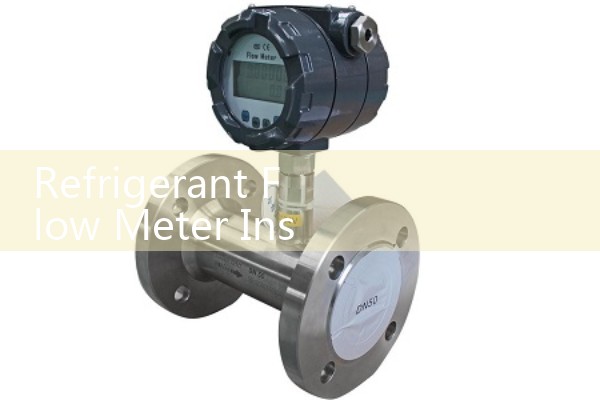
Mount the meter in a location where the refrigerant stays liquid. Subcool the liquid by at least 5 Kelvin to avoid bubbles. If you are measuring refrigerant vapor, keep the gas dry and away from saturation. In severe duty systems with oil carryover, choose a meter type that can handle mixed-phase flow, such as a Coriolis meter.
Silver Instruments recommends checking the manufacturer installation manual for the exact straight pipe length for your meter model and piping configuration. Our support team can review a piping isometric drawing and confirm the needed dimensions.
Use a flow conditioner only when you cannot achieve the recommended straight pipe. A Zanker or tube-bundle conditioner can shorten upstream length by half. But a flow conditioner adds pressure drop and cost. In many cases, a Coriolis meter eliminates the problem altogether and costs less than a vortex meter plus conditioner plus extra pipework.
Refrigerant Flow Meters from Silver Automation Instruments
Silver Instruments builds several flow meter types that meet ISO 10770 or ASME B31.5 for refrigeration. The SICM Coriolis mass flow meter is a direct mass measurement device with no moving parts and no straight pipe requirement. It outputs 4-20 mA HART, pulse, and RS485 Modbus. It handles temperatures from -200 °C to 200 °C and pressures up to 100 bar. Typical accuracy is 0.15 percent of rate. This meter is ideal for OEM chiller test benches, heat pump performance testing, and refrigerant charging stations.
We also supply vortex flow meters with integrated RTD temperature sensors for refrigerant vapor measurement. These meters need 30D straight upstream and 5D downstream, but they cost less than Coriolis for large pipe sizes. For brine or ammonia, our electromagnetic flow meters are a robust choice with a short straight run of 5D.
Frequently Asked Questions
Q: Do I need straight pipe for a Coriolis flow meter in a refrigerant system? No. Silver Instruments Coriolis meters need zero straight pipe. You can install them directly after a pump or bend.
Q: What is the minimum straight run for a vortex flow meter on R410A liquid line? 30D upstream and 5D downstream for a single elbow configuration. More if there are control valves.
Q: Can I use a flow straightener to reduce the straight pipe requirement? Yes, but it adds pressure drop and expense. In many packed assemblies, a Coriolis meter is a simpler fit.
Q: How do I calculate D for a DN40 pipe? D equals the nominal bore, so 40 mm. 30D is 1200 mm. Use the exact inner diameter from your pipe schedule for precise placement.
Q: Where do I place the flow meter when there is a solenoid valve upstream? For vortex meters, keep at least 40D between the valve and the meter. For electromagnetic meters, 10D is enough. With a Silver Instruments Coriolis meter, you do not need any distance. Just avoid two-phase flashing.
Send us your refrigerant type, operating pressure (bar), temperature (°C), pipe size (DN), and required flow range. Email [email protected] or call +86-25-68650347. You can also message us on WhatsApp at +86-25-52155837 or WeChat: +86 15365082610. Tell us your application and we will recommend the right flow meter and confirm the straight pipe layout.